
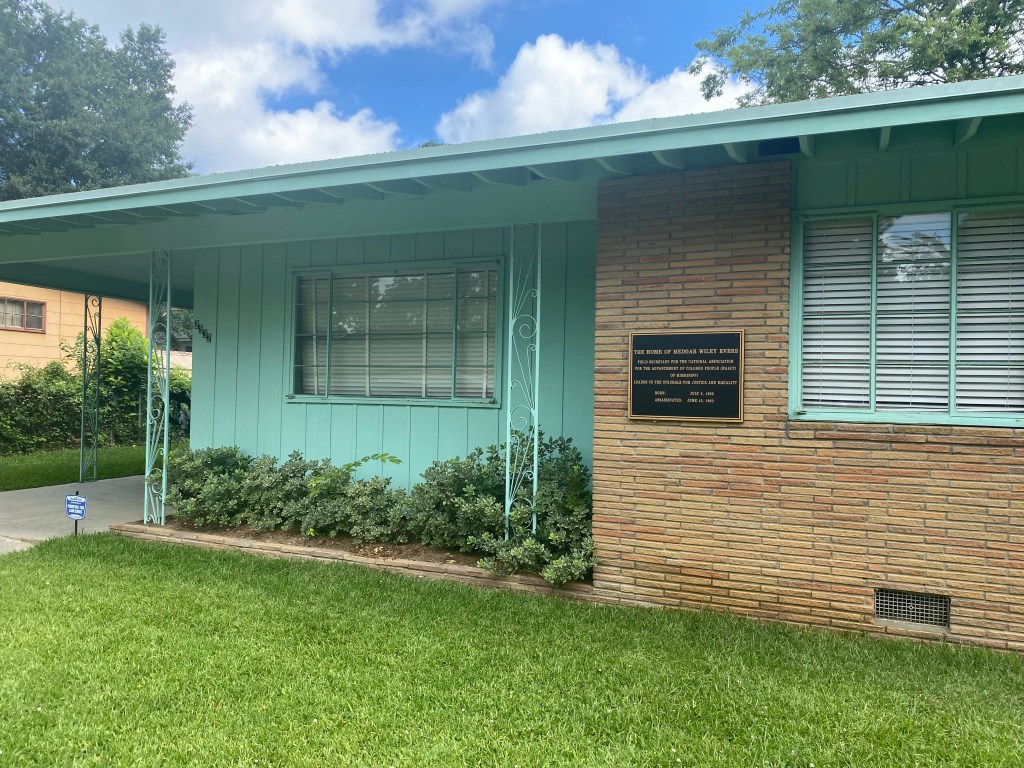
2332 Margaret W Alexander Dr, Jackson, MS 39213
It was in Jackson that a civil rights activist named Medgar Evers was living. In 1955, the same year that Emmitt Till was killed just hours away, Medgar Evers had applied for admittance to the University of Mississippi’s law school, he was denied due to his race. After receiving the rejection letter from the University of Mississippi Medgar Evers reached out to the NAACP (National Association for the Advancement of Colored People) and as result he was invited to be one of the first field agents in Mississippi. Soon thereafter he was assigned the case of investigating the assignation of Emmitt Till. Medgar Ever’s was a Black activist whose job it was to investigate crimes again Black bodies. Medgar also won the battle to integrating University of Mississippi (“Ole Miss”, as it’s called as a term of endearment -however, this is also what enslaved Africans were told to call the master’s wife “Ole Miss”) when he accompanied James Meredith (another young Black man) to register for classes a riot incited which led to President JFK sending in 30,000 National Guard. Thanks to the strength and leadership of Medgar Evers, James Meredith did successfully desegregate U of M in 1962.
In 1964, just hours after President John F. Kennedy had given a speech to the nation recognizing that the civil rights movement was a moral, and not purely legal, issue. The country was preparing to pass the Civil Rights Act of 1964. Medgar’s family watched the speech on TV while he was planning a protest and upon his return home he was shot in the back and killed. When he arrived, still alive, at the hospital that his neighbor had driven him to he was initially denied care because of his race. However, a nurse and a doctor who happened to be working that night at the hospital recognized Medgar and he received care after all, but it was no use.
That night was not the first that his home had been bombed or shot up, in fact Medgar was so aware of the threat to him and his family that he had the windows raised and the bed frames removed. The family all slept on mattresses on the floor, so that no one could see his them moving around their home. He had the house built so that the front door was on the side of house, under the carport, so that his children could go straight from the car to inside the house for safety from shooters. After his death his wife and children moved away from Mississippi to California. After two hearings that both resulted in hung juries, with all white jurors, killer, Byron De La Beckwith was set free. More than 30 years later, after much persuasion from leaders and the Evers family, Beckwith was tried again for the murder in 1994 and at the age of 73 he was sentenced to life in prison, where he died in 2001.
Today, Medgar Evers house is a historical site. You might notice that often profoundly significant Black historical sites are not maintained financially. In this case we could peek in the windows and see what the house might have looked like. I understand from research that the house was restored to its 1960’s appearance by a Hollywood Film agency for the filming of the movie, Ghost of Mississippi. Without this kind of funding the house would have remained another ruin of Black history.
Standing in the same driveway that Medgar Evers was fatally shot was a profound experience. Much like the experience of walking through the Lorraine Motel where Dr. MLK spent his last night or where Malcolm X said his last words. As I reflect on standing where these heroes stood it feels like I have stood on holy lands, there is deep reverence and spiritual connection.

 Black History Tour